Showing posts with label South Yorkshire. Show all posts

Wednesday, 9 May 2018

South Yorkshire and the Cold War

Less than thirty years ago we lived with the threat of nuclear Armageddon. The stand-off between East and West ran from the end of the Second World War to 1991, the year the USSR collapsed. Here's how South Yorkshire fitted into the conflict. 

Soviet targets


RAF Finningley near Doncaster, with its 'V' bomber aircraft, was considered a target for the Soviets. Indeed, nuclear bombs were kept on this airfield in the late 1950s. New Scientist reported in 2001 there was a high accident risk in test flights, as the bombs contained so much fissionable material.

Control tower at RAF Finningley
Cold War–era control tower at RAF Finningley

The region's coal mines, roads, rail links and steelworks would have made attractive sites for Moscow, too. Sheffield's Forgemasters manufactured parts for Trident nuclear submarines.

The campaign for peace


Sheffield hosted the World Peace Council's conference in 1950, with Pablo Picasso in attendance. The organisation was set up to encourage disarmament, but the British authorities saw it as 'bogus', undermining it by refusing many delegates' visa applications, and it was never held in Britain again.

That marked the start of South Yorkshire's defiance against the government's nuclear policies. In 1956 Sheffield made a gesture of friendship with a Soviet city, twinning with Stalino (now Donetsk in Ukraine). People set up local CND branches. In 1980 the County Council declared itself 'nuclear free', opposing any hosting or transportation of nuclear materials here.

In 1984 Threads, a docudrama written by Barnsley's Barry Hines (writer of Kestrel for a Knave) was broadcast. It depicted the effects of a nuclear winter in Sheffield, traumatising a generation.

Threads by Barry Hines Sheffield

It was fighting in Iran that led to the UK being hit.

Threads Iran nuclear war

South Yorkshire County Council's South Yorkshire and Nuclear War booklet


In December 1983 the government brought in a new law requiring councils to extend civil defence. SYCC's Policy Research Unit was scornful. It published a public information booklet in September 1984, declaring any plans to survive a nuclear attack 'utterly futile'.

South Yorkshire and Nuclear War


The booklet describes what would happen if central government's 1980 'Square Leg' exercise had been real. That study assumed two bombs (250 times bigger than the Hiroshima bomb) would drop in South Yorkshire, one on Eccleshall Road in Sheffield, and one near Finningley airfield near Doncaster.

Radioactive fallout in South Yorkshire

A blinding flash of light, then a huge fireball as hot as the sun incinerates everything beneath it. Blast winds destroy buildings, sucking up tonnes of dust into a mushroom cloud. At the impact point, each bomb leaves a crater a third of a mile across and 300 feet deep. Cars melt, rivers run dry and people burn. Those in shelters are roasted.

Any survivors bear hideous injuries and burns and face a nuclear winter. The skies are dark with smoke and dust. Chemical smog chokes the atmosphere and temperatures drop to –23°C. Eventually everyone dies. Only insects and grass remain.

The Council considered the Home Office's Square Leg prediction of 190,000 dead (within six weeks) in South Yorkshire an underestimate. It commissioned an independent computer simulation, and concluded 934,000 would die out of 1,292,000 residents.

It described the belief in the need for nuclear weapons as 'absurd', comparing it to a householder blowing their house up to stop being burgled. On the likelyhood of nuclear war, there's no message of hope. It said "every arms race in history has ended in war, and it seems doubtful the nuclear arms race will be an exception".

What remains today


A few remnants of the Government's 'futile' civil defence plans remain. The Royal Observer Corps was set up in the 1950s to monitor the effects of an attack. Hundred of small bunkers were built around the country and you can find examples in Lindholme, Rossington, Abbeydale golf course and elsewhere.

Lindholme bunker
A bunker next to the (locked) ROC bunker at Lindholme

Regional government headquarters were built underground. There's one in Conisbrough, which is now a private house, and there are bunkers under Cusworth Hall and Barnsley County Hall. Doncaster's Emergency Borough Control Centre was on Cleveland Street, underneath the Coroner's Office. It was demolished last year.

Doncaster Borough Control
Doncaster Borough Control – 2017 and 2001 (latter photo: Nick Catford)
Cusworth bunker
Bunker at Cusworth Hall (South Yorkshire and Nuclear War, 1984)

Sunday, 12 March 2017

Going Underground in Donny

Emergency 'Borough Control' centres were built in many towns in the UK during the Cold War.

The bunkers were designed to serve as boltholes for the town's leadership and emergency services from where they could coordinate activity and communications in the event of nuclear attack.

Rear

Doncaster's was built in the '60s under the Coroner's Court.

Front

It's now in the process of demolishment, so it was decided to carry out a perfunctory inspection before a game of darts at the welcoming Corner Pin pub around the corner.


Above was the Signals room. Compare with the photo below of SubBrit's visit in 2003.


All rooms were largely stripped out and it was difficult to determine their use, but there would have been Administration, Operations, Scientists & Reconnaissance, Conference & Controllers and Plant, as well as toilets and a kitchen.


According to SubBrit, "the plant room has a Braby generator, switchgear and ventilation and filtration plant by Keith Blackman Engineering of London, the unit being called 'The Tornado.'"


Emergency hatch

With the removal of such refuges, we can hope their need is now also gone.

Sunday, 3 January 2016

South Yorkshire's grandest Woodhouse

Wentworth Woodhouse, one of the finest Georgian houses in England has recently had a sale agreed to a Hong Kong based investment company.

Painting from A Complete History of the County of York by Thomas Allen (1828–30)

'Woodhouse' is hardly befitting a name. It's a grandiose mansion with the longest facade in Europe (>600ft) and is bigger than Buckingham Palace. The history is full of intrigue and feud - Wikipedia's article is a starting point.

At £8 million the Lake House Group may have been less than the price of some London flats, but it'll be many times that amount to restore and maintain.

The stunning house continues to open occasionally for tours, so it was decided to investigate the outlying areas to see what else the new owners will be taking on.

Follies dot the estate and surrounding areas - this is the Rockingham Monument or Mausoleum at dawn. It's no longer part of the estate.


About a mile away, fenced off Doric Temple forms an equilateral triangle with the above and Hoober Stand, a 100ft pyramidal watchtower, each visible from the other two.

Doric Temple

Hoober Stand (taken on a previous visit)


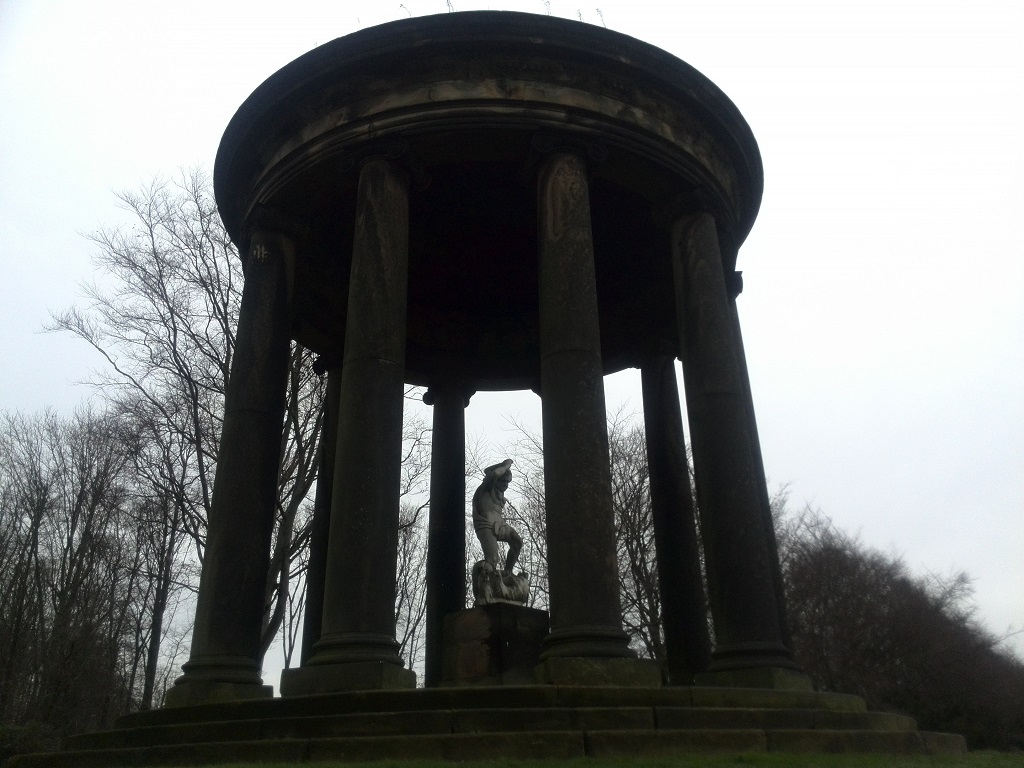
Ionic Temple. Hercules is clubbing a mythical beast.


Grade II* listed at-risk Camellia House - rear conservatory.


Front


West of the house is the former stables and riding school. It became part of Lady Mabel College, which taught would-be female PE teachers.


Now a handful of small businesses occupy the stables and some activity takes place in the newer part of the college which includes a swimming pool, but much lies derelict, including the riding school turned gym.


Magazines up to 50 years old - this Tatler is from the early 80s.


Detailed accounts of a previous owner.


Skylights.


Rain started to fall. These grey, functional halls of residence to the north were doubtful the deal-maker.


Finally, the front facade.


Thanks for viewing!

Sunday, 30 August 2015

Colliery exploratory: Hatfield

Hatfield's first deep shafts were sunk during WW1 by the Hatfield Main Colliery Company.


Ownership transferred to the Carlton Main Colliery Company in 1927 before it became part of the National Coal Board in 1947, closing under British Coal ownership in 1993. Hatfield Coal Company announced plans to reopen a year later and though it made a profit in its first year of operation, it eventually closed in 2001.

In the same year RJB Mining took over - its parent company Coalpower had plans to build a power station but problems led to Coalpower going into administration and closure in 2004.


Buoyed by rising coal prices, mining resumed under Powerfuel in 2006, who had plans for a carbon capture and storage power station which unfortunately also ran into problems and saw Powerfuel go into administration in 2010.

In December 2013 the employee-led Hatfield Colliery Partnership Limited bought the mine with plans to move production to a new pit face, but 18 months later factors such as "low coal price, a switch to renewable energy and large coals stocks" (BBC) saw it cease again, with HCPL wound up earlier this month.

An exploratory seemed appropriate.

Most main buildings seemed sealed but it was possible to inspect some of the machinery, conveyor belts and a headstock.

These belts would take coal away from the pit to be taken away by lorries or rail via the track further left.


Interesting switch box in the left-hand building above.


Headstock 1 seemed to have been the best maintained.


Everything here is covered in grease.


Including the steep stairs.


No. 2 Winding House - to be looked into.


That's all for now, thanks for viewing!