Sunday, 25 August 2019

Eastriggs Munitions Depot, Dumfriesshire

An expanse of land on the Solway Coast was once part of the world's biggest factory.

Later it was a depot forming part of Britain's largest ammunition storage facility, some of which is still in use. This depot was mothballed in 2011.

The nine-mile site was built during World War One. Less than a year into the war, Allied troops on the Western Front faced a shortage of artillery shells. The situation led to what became known as the Shell Crisis of 1915 and the fall of the Asquith government.

A new coalition government set up a Ministry of Munitions to gear the whole economy towards the war effort. HM Factory Gretna, according to Arthur Conan Doyle, was "the newest, the largest, and the most remarkable" of the forty new munitions factories in Britain. Its sole aim was to make cordite propellant, which fired soldiers' bullets and shells.

The complex covered the English-Scottish border from Dornock to Longtown.

Maps courtesy The Devil's Porridge museum
Gretna and Eastriggs townships were built by 10,000 Irish navvies to accommodate the over 16,000 mainly female workers who would work shifts in the factories. The dangerous work went on 24 hours a day to ensure a constant supply of munitions to the front line.

Eastriggs was site 3, where the chemical processes took place to make the explosive paste, nicknamed the Devil's Porridge, to be sent to Mossband (site 2) to create cordite.

After the war the sites were sold off, only to be needed again in World War 2 for the storage and distribution of explosives.


Following that war, the Eastriggs facility became part of DSDA (Defence Storage and Distribution Agency) Longtown, housing 63 Explosive Storehouses.

In 2011 the site was mothballed, and the explosive materials transferred to Longtown.

The reception area has buildings dating back to the First World War.


More wartime buildings remain further into the site.


Much of the 25 miles of narrow-gauge railway track was removed in 2016 by a Worksop firm and sold to projects ranging from heritage tourism in London to a sugar cane plantation in Puerto Rico.


Elsewhere more modern buildings remain sealed, with the site left for nature to enjoy.


There's been hope the place could be developed, perhaps as a visitor centre or for nature tourism. However, the remote location and fears about contamination mean that for now, it remains undisturbed.

Monday, 29 April 2019

Shipton ROTOR SOC and RGHQ bunker


Under this bungalow lies a Cold War bunker that has remained under MOD control since it was stripped out in 1993.


It's one of six radar centres set up in 1953 for the ROTOR project. The others were Box, Bawburgh, Goosnargh, Barnton Quarry and Kelvedon Hatch. They used information received from radar stations to direct aircraft and intercept any attack.


In the 60s, following the invention of the atom bomb, it became a headquarters for local authorities to shelter and coordinate action in the event of nuclear war. This one covered Leeds to Teesside.


After the Cold War ended, it fell into disuse, but remains secure and under active surveillance. 


The warning sign at the entrance indicates "HMX Crown Property".


Its current use remains an enigma. 

Wednesday, 9 May 2018

South Yorkshire and the Cold War

Less than thirty years ago we lived with the threat of nuclear Armageddon. The stand-off between East and West ran from the end of the Second World War to 1991, the year the USSR collapsed. Here's how South Yorkshire fitted into the conflict. 

Soviet targets


RAF Finningley near Doncaster, with its 'V' bomber aircraft, was considered a target for the Soviets. Indeed, nuclear bombs were kept on this airfield in the late 1950s. New Scientist reported in 2001 there was a high accident risk in test flights, as the bombs contained so much fissionable material.

Control tower at RAF Finningley
Cold War–era control tower at RAF Finningley

The region's coal mines, roads, rail links and steelworks would have made attractive sites for Moscow, too. Sheffield's Forgemasters manufactured parts for Trident nuclear submarines.

The campaign for peace


Sheffield hosted the World Peace Council's conference in 1950, with Pablo Picasso in attendance. The organisation was set up to encourage disarmament, but the British authorities saw it as 'bogus', undermining it by refusing many delegates' visa applications, and it was never held in Britain again.

That marked the start of South Yorkshire's defiance against the government's nuclear policies. In 1956 Sheffield made a gesture of friendship with a Soviet city, twinning with Stalino (now Donetsk in Ukraine). People set up local CND branches. In 1980 the County Council declared itself 'nuclear free', opposing any hosting or transportation of nuclear materials here.

In 1984 Threads, a docudrama written by Barnsley's Barry Hines (writer of Kestrel for a Knave) was broadcast. It depicted the effects of a nuclear winter in Sheffield, traumatising a generation.

Threads by Barry Hines Sheffield

It was fighting in Iran that led to the UK being hit.

Threads Iran nuclear war

South Yorkshire County Council's South Yorkshire and Nuclear War booklet


In December 1983 the government brought in a new law requiring councils to extend civil defence. SYCC's Policy Research Unit was scornful. It published a public information booklet in September 1984, declaring any plans to survive a nuclear attack 'utterly futile'.

South Yorkshire and Nuclear War


The booklet describes what would happen if central government's 1980 'Square Leg' exercise had been real. That study assumed two bombs (250 times bigger than the Hiroshima bomb) would drop in South Yorkshire, one on Eccleshall Road in Sheffield, and one near Finningley airfield near Doncaster.

Radioactive fallout in South Yorkshire

A blinding flash of light, then a huge fireball as hot as the sun incinerates everything beneath it. Blast winds destroy buildings, sucking up tonnes of dust into a mushroom cloud. At the impact point, each bomb leaves a crater a third of a mile across and 300 feet deep. Cars melt, rivers run dry and people burn. Those in shelters are roasted.

Any survivors bear hideous injuries and burns and face a nuclear winter. The skies are dark with smoke and dust. Chemical smog chokes the atmosphere and temperatures drop to –23°C. Eventually everyone dies. Only insects and grass remain.

The Council considered the Home Office's Square Leg prediction of 190,000 dead (within six weeks) in South Yorkshire an underestimate. It commissioned an independent computer simulation, and concluded 934,000 would die out of 1,292,000 residents.

It described the belief in the need for nuclear weapons as 'absurd', comparing it to a householder blowing their house up to stop being burgled. On the likelyhood of nuclear war, there's no message of hope. It said "every arms race in history has ended in war, and it seems doubtful the nuclear arms race will be an exception".

What remains today


A few remnants of the Government's 'futile' civil defence plans remain. The Royal Observer Corps was set up in the 1950s to monitor the effects of an attack. Hundred of small bunkers were built around the country and you can find examples in Lindholme, Rossington, Abbeydale golf course and elsewhere.

Lindholme bunker
A bunker next to the (locked) ROC bunker at Lindholme

Regional government headquarters were built underground. There's one in Conisbrough, which is now a private house, and there are bunkers under Cusworth Hall and Barnsley County Hall. Doncaster's Emergency Borough Control Centre was on Cleveland Street, underneath the Coroner's Office. It was demolished last year.
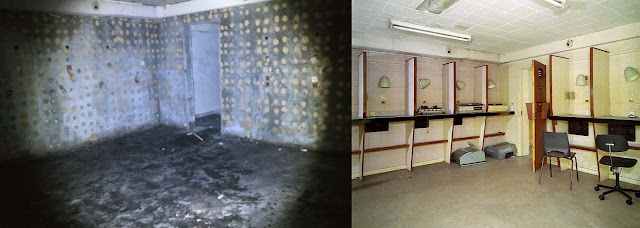
Doncaster Borough Control
Doncaster Borough Control – 2017 and 2001 (latter photo: Nick Catford)
Cusworth bunker
Bunker at Cusworth Hall (South Yorkshire and Nuclear War, 1984)

Saturday, 9 December 2017

Welcome to Hel

A 20 mile long wooded sand bar peninsula lies off Poland's Baltic coast.

Hel peninsula
Poland and Germany after WW1
After WW1 it was a crucial part of Polish corridor to the sea. They built it up militarily in the 1930s in response to the Nazi threat with a naval base, underground power plant, underground petroleum reservoir and extensive artillery.

The Battle of Hel was Polish forces' last stand in 1939. 2,800 soldiers held out against all odds, dynamiting a narrow section to create an island, surrendering a month later.
Hel peninsula
Landsat photo
During WW2 the Germans built a U-boat training facility, batteries, a radar station and started work on an airfield. However in May '45 the roles were reversed. German soldiers with refugees, having fled from the mainland, fought for six days after Germany had surrendered before they themselves surrendered to the Soviets.

Under Communist rule the spit became one of the most protected military areas in the country. In time coastal artillery became less important, and most of what remained was designated military monuments in 1999.

The whole length is strewn with relics. We hoped to rent bikes to see more, but alas found none and just explored the part near the town of Hel on foot. I didn't note which were Polish, German or Soviet, but here's an idea what's there:

Gun battery

Trench

Gun turret

Inside the radar tower
Looking down from the radar tower

Entrance to the radar tunnel

Inside the radar tunnel


Battery command centre

Fire command post

Gun battery

Gun emplacement
A must visit for anyone visiting northern Poland.


Sunday, 3 December 2017

Upper Heyford's hardened buildings

Dogged reminders of 20th Century global conflict sit on a plain near Bicester in Oxfordshire.

Upper Heyford is the best preserved Cold War base in Britain, with hundreds of fascinating concrete structures, and there's always something new to discover.


The former RAF base was allocated to the USA's Strategic Air Command in the 1950s. Its purpose was to retaliate with bombers to any Soviet nuclear strike, which would lead to mutually assured destruction (MAD).

Tension must have been high during the Cuban missile crisis of 1961 when the end of the world looked possible—it would have started from here. But by the late 60s America's focus had shifted toward places such as Vietnam, and development here slowed for a time.

Then in the 70s, they pursued a more 'flexible response' strategy, and F-111 bombers arrived. The Arab-Israeli War had shown unprotected aircraft were vulnerable to attack, so they built new bombproof hangars and buildings.

Building number 299 – Avionics

The aircraft electronics facility is in the south-west of the airfield, near the main vehicular entrance. The nature of the work meant nothing magnetic was allowed in.


Building number not known – Quick Reaction Alert (or Victor Alert) entrance

Behind this guard house, nine F-111s stood in concrete hangars on 24-hour standby, ready to attack Moscow.

Quick Reaction Alert (or Victor Alert) entrance


2010 – QRA Command Centre

The command centre for the planes on standby.


234 – 55th Aircraft Maintenance Unit

Just north of the QRA area is one of the squadron headquarters. Staff looking after the standby aircraft worked here. Historic England gives this one a separate listing, thanks to its completeness and good condition. It's now part of a police training area.

55th Aircraft Maintenance Unit

383 –  42nd Electronic Countermeasures Squadron HQ

This is newer than the other three squadron HQs. Like the others, it has a normal entrance and a 'dirty' one, connected to decontamination showers for anyone coming in with radiation.

42nd Electronic Countermeasures Squadron HQ

209 – 77nd Tactical Fighter Squadron HQ

Now occupied by a business, it's identical to the 55th and 79th squadrons' buildings. 


# n/k – Northern Bomb Store entrance 

Fortress guarding the nuclear bomb storage area:


1017 – Trigger Store

This held the capsules, or trigger mechanisms for the nukes. 

Front
The windows are fake, to make it look like an office. According to Historic England's 2017 "A reassessment of the flying field Conservation Area" report,
It is […] a solid concrete block, with a small, secure interior vault where nuclear capsules, or triggers might be stored. The capsules were held in pressurised tubes within a rectangular, open, tubular frame, known as a "Birdcage", and kept in the vault in open lockers about 0.91cm square. The vault might house up to 30 devices.
Rear
Vault

370 – 79th Tactical Fighter Squadron HQ

Within the car distribution area in the south, this is one of the least taken care of buildings at the base. Nature is taking over, on the outside at least. 

79th Tactical Fighter Division HQ
Exterior

Interior
Decontamination shower

Console for controlling entry

129 – Telephone Exchange

Built to maintain lines of communication in the event of an attack; it's still in use. 


126 - Command Centre

The nerve centre of the base was built in a nondescript corner of the airfield to hinder identification by the enemy.


Upper Heyford's civilian side is being turned into a busy commuter village. These striking buildings on the airfield are thankfully protected from the bulldozers by their listed status, and from the elements by their defensive, weatherproof designs.

For more photos of Upper Heyford see an earlier post.